Interface shear test
This benchmark validates frictional contact in numgeo by simulating a large-scale interface shear test. A stiff wall is brought into contact with a linear-elastic soil body and then moved tangentially relative to the soil. The interface follows the Coulomb friction law described in the contact theory documentation. The supplied models use a friction coefficient of \(\mu=0.364\), zero adhesion, and a fixed normal penalty stiffness of \(10{,}000\) in the consistent model-unit system.
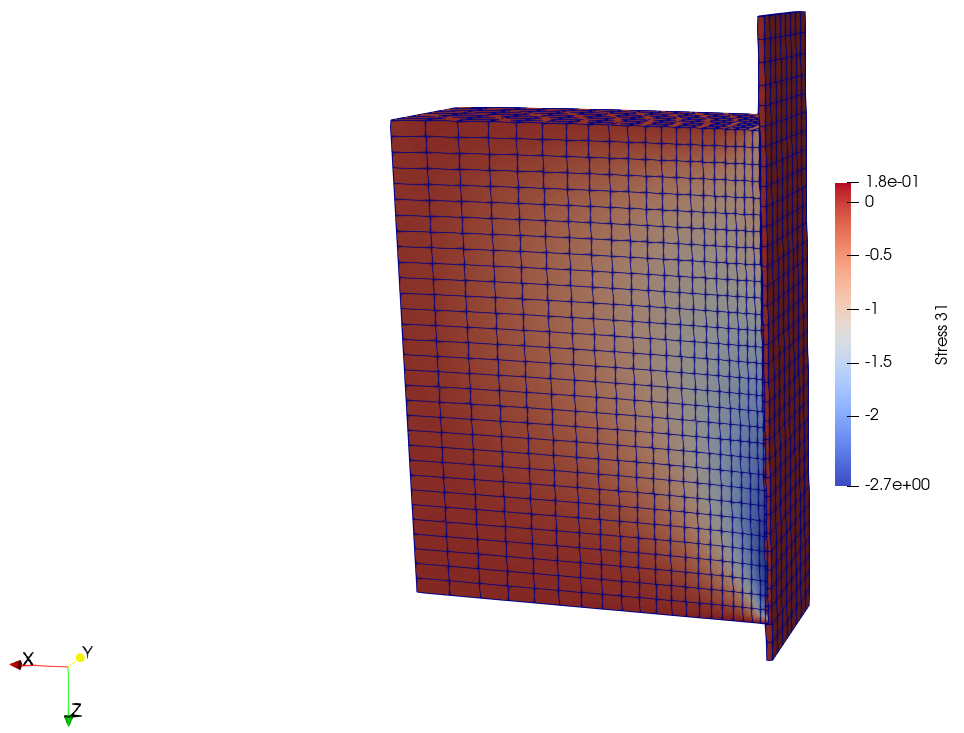
Figure 1: Finite-element model of the large-scale interface shear test.
The benchmark covers the following discretisations and solution procedures:
| Model | Elements | Contact discretisation | Solution procedure |
|---|---|---|---|
2D_EBM |
quadratic quadrilaterals | element-based mortar (EBM) | static implicit |
2D_SBM |
quadratic quadrilaterals | segment-based mortar (SBM) | static implicit |
2D_tri_EBM |
linear triangles | element-based mortar (EBM) | static implicit |
3D_EBM |
linear hexahedra | element-based mortar (EBM) | static implicit |
3D_EBM_quadratic |
quadratic hexahedra | element-based mortar (EBM) | static implicit |
3D_EBM_explicit |
linear hexahedra | element-based mortar (EBM) | explicit dynamic with mass scaling |
Input files
The input files and reference results can be downloaded here.
Simulation results
The normal and tangential contact stresses are evaluated during the shearing stage. All models reproduce the expected Coulomb limit: after mobilisation, the tangential stress remains close to \(\mu\) times the compressive normal stress. Small differences in the normal stress are caused primarily by the different meshes and by the fact that the contact quantities are not sampled at exactly the same physical location in every model. This is most visible for the two-dimensional triangular model.
The horizontal coordinate in the legacy comparison plot below is the elapsed time of the shear step, ranging from 0 to 0.3. Although the embedded image labels this coordinate as wall displacement, it is not the physical displacement. The prescribed wall velocity or displacement ramp has a reference magnitude of 0.058 m per unit step time; therefore, the magnitude of the physical displacement is \(0.058\) times the plotted shear-step coordinate. This distinction does not affect the stress comparison.
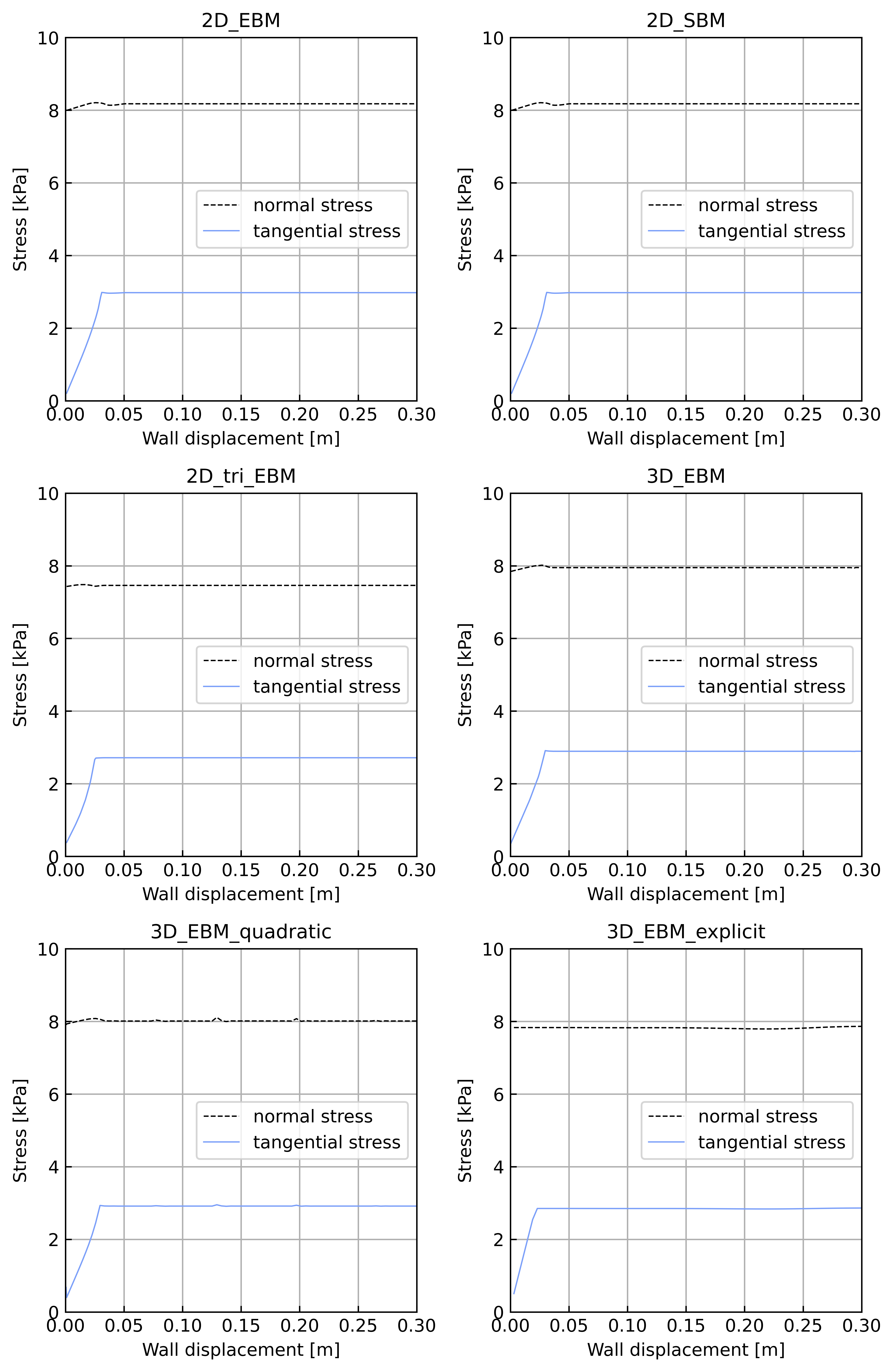
Figure 2: Normal and tangential contact stresses for the two- and three-dimensional interface shear-test variants. See the note above regarding the horizontal coordinate.