numgeo-PFEM - A Particle Finite Element Method (PFEM) for geotechnical applications
The simulation of installation processes, slope failures, and ground improvement measures remains a major challenge for applied numerical methods in geotechnical engineering. These problems are typically characterised by large deformations, evolving free surfaces, and significant changes in topology. As a result, the complex deformation states that arise during such processes cannot yet be represented satisfactorily using conventional finite element approaches.
To address these challenges, numgeo-PFEM is currently being developed. It extends the Finite Element (FE) program numgeo, by enabling simulations based on the Particle Finite Element Method (PFEM) within this framework. By combining PFEM with the robust constitutive modelling capabilities of numgeo, the framework allows the simulation of large-deformation geotechnical boundary value problems while employing sophisticated consitutive models.
DFG Project
Within the framework of this German Research Foundation (DFG) project, the Particle Finite Element Method (PFEM) will be further developed for the treatment of dynamic problems as they occur in geotechnical engineering. This particularly requires the consideration of inertia terms and wave propagation phenomena in fluid-saturated media.
The modelling and algorithmic development will be carried out through an interdisciplinary collaboration between geotechnics (Jan Machacek) and mechanics (Ralf Müller) at Technische Universität Darmstadt (TUDa), involving Jan Machacek and Ralf Müller. Implementation will be realised within the finite element program numgeo (Machacek & Staubach).
Project information
Project kick-off: 2024
Project partners:
- Prof. Dr.-Ing. Jan Machacek, Institute of Geotechnics (IfG, TUDa)
- Prof. Dr.-Ing. Ralf Müller, Institute for Mechanics (IfM, TUDa)
- Antaues Bettmann, M.Sc. (IfG, IfM)
GEPRIS: Projekt 517723402
PFEM
The Particle Finite Element Method (PFEM) enables the treatment of such complex topological changes while simultaneously accounting for sophisticated nonlinear constitutive models. It combines the established Finite Element Method (FEM) with continuous remeshing, thereby minimising excessive mesh distortions. The general algorithm of a PFEM simulation is illustrated in Figure 1.
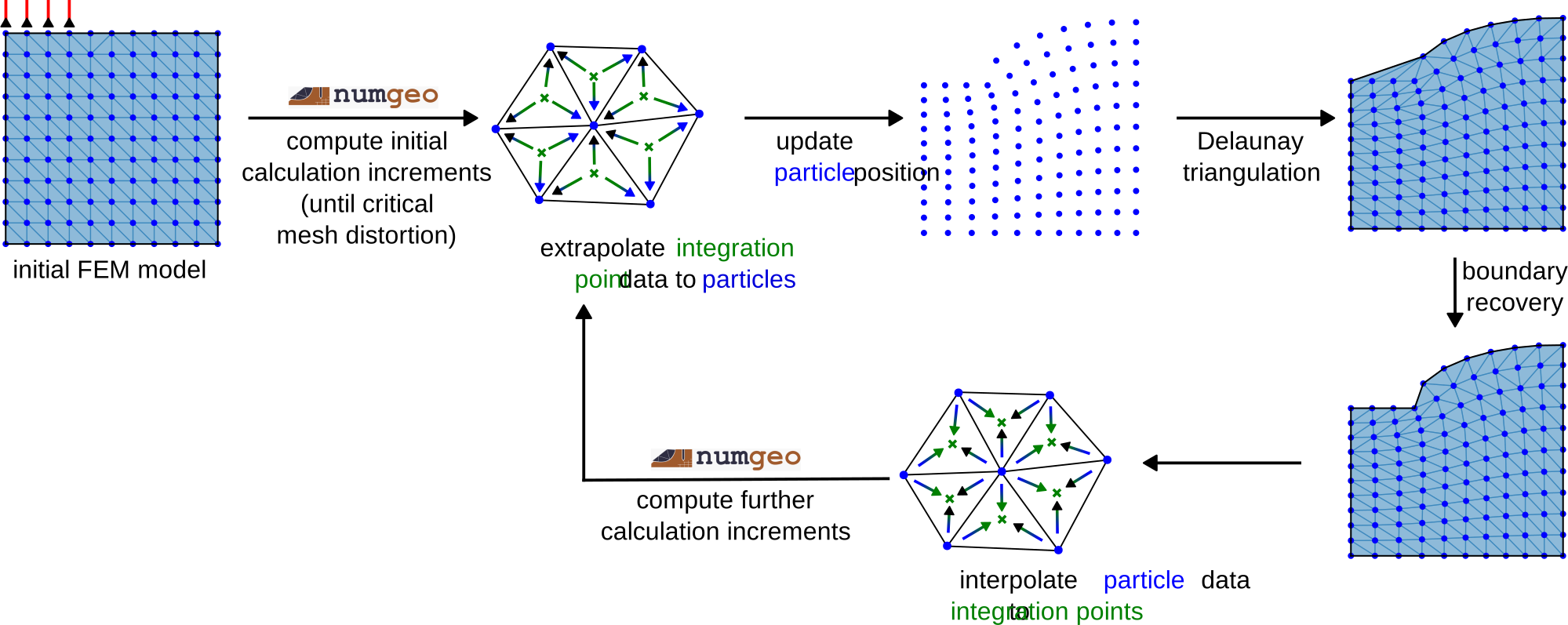
Figure 1: PFEM-Algorithm
The PFEM begins with a standard FEM simulation, which is advanced incrementally until the computational mesh exhibits critical distortion. At this point, a remeshing procedure is initiated to restore mesh quality. During remeshing, the element topology is discarded but the nodal positions are preserved. To prevent the loss of information stored at the integration points (IGPs) such as stresses, strains, or any other state variables, these values are extrapolated to the nodes of the computational mesh before remeshing. Then, the element connectivity is deleted. At this stage, all relevant physical quantities are carried by the nodes, which are conceptually treated as particles — thus giving the method its name.
A new mesh is then generated over this particle cloud using Delaunay triangulation (Delaunay, 1934)1, resulting in a mesh composed of linear triangular elements that define the convex hull of the domain. However, since the convex hull does not necessarily coincide with the physical boundaries of the problem domain, a boundary recovery algorithm — typically the \(\alpha\)-shape algorithm (Edelsbrunner and Mücke, 1994)2 — is employed. This algorithm uses a geometric criterion to identify and remove spurious elements. It exploits the observation that non-physical elements introduced during triangulation often exhibit higher skewness compared to genuine elements.
For solid mechanics applications, however, the frequent connection and disconnection of domains is generally less relevant than in fluid mechanics (e.g. free-surface fragmentation in splashing simulations). An alternative approach for the mesh generation based on the constrained Delaunay triangulation can be used, omitting the \(\alpha\)-shape method. The constrained Delaunay triangulation follows the same principles as the standard Delaunay triangulation, with the additional restriction that the original boundary prior to remeshing is preserved and the generation of new elements is permitted only within this boundary. Consequently, the two steps shown on the right-hand side of Figure 1 can be combined into a single operation.
To reinitialize the stresses, strains and other state variables at the IGPs of the new mesh, the nodal values (previously extrapolated from the old IGPs) are interpolated back to the IGPs of the new mesh using the shape functions of the newly defined elements. The FEM simulation is then resumed and proceeds by further increments until mesh distortion again reaches a critical threshold, triggering the next remeshing cycle. This loop, comprising extrapolation, remeshing, interpolation, and the computation of calculation increment using FEM, is repeated until the simulation is completed.
One drawback of the classical PFEM algorithm is its reliance on extrapolation and interpolation procedures for transferring state variables between successive computational meshes. To address this issue, several alternative mapping techniques are implemented in numgeo-PFEM.
In addition to the remeshing of existing particles, particles can also be removed or inserted in order to adaptively improve mesh quality.
-
Delaunay, B. (1934) "Sur la sphère vide," Bulletin de l'Académie des Sciences de l'URSS. Classe des sciences mathématiques et Naturelles, (6), pp. 793--800. ↩
-
Edelsbrunner, H. and Mücke, E.P. (1994) "Three-dimensional alpha shapes," ACM Transactions on Graphics, 13(1), pp. 43--72. Available at: https://doi.org/10.1145/174462.156635. ↩