1D Consolidation
The one-dimensional consolidation theory (Terzaghi, 1925)1 describes the time-dependent settlement behaviour of low-permeability soils and can be used to compute the dissipation of excess pore water pressure, Δpw, and its conversion into effective stresses according to
\(\frac{\partial \Delta p_w (z,t)}{\partial t} = c_v \frac{\partial^2 \Delta p_w (z,t)}{\partial z^2}\)
To investigate the ability of the PFEM to accurately capture the dissipative behaviour of pore water pressure, a 1D model shown in Figure 1 is considered. The saturated soil column has a height of \(H=1\,\mathrm{m}\) and a width of \(0.025\,\mathrm{m}\). The soil column was discretised using 80 elements, resulting in a nodal distance of \(0.025\,\mathrm{m}\).
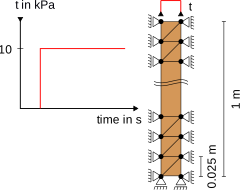
Figure 1: Model of 1D consolidation
For linear shape functions, equal-order interpolation of solid displacement \(\mathbf{u}\) and pore water pressure \(p_w\) violates the LBB condition. Therefore, a stabilized formulation is employed using the pressure Laplacian stabilization technique (Brezzi and Pitkäranta, 1984; Truty and Zimmermann, 2006)2 3. For quadratic interpolated elements, the Taylor-Hood formulation is used, where \(\mathbf{u}\) is interpolated with quadratic shape functions and \(p_w\) with linear shape functions.
The soil permeability was assumed to be \(K = 10^{-12}\,\mathrm{m}^2\), and the dynamic viscosity of water was set to \(\mu^w = 10^{-6}\,\mathrm{Pa \cdot s}\), resulting in a hydraulic conductivity of
\(k_f = K \cdot \frac{\gamma_w}{\mu^w} = 10^{-12} \cdot \frac{9.81}{10^{-6}} = 9.81\cdot 10^{-6}\,\mathrm{m/s}\)
The total simulated time is 10,000 seconds.
The soil is modeled as a linear elastic material characterized by a Young’s modulus \(E = 500\,\mathrm{kPa}\) and a Poisson’s ratio \(\nu = 0.35\). The vertical boundaries are constrained in the horizontal direction to prevent lateral displacements, while the bottom boundary is fully fixed. A Heaviside-type load of magnitude \(t=10\,\mathrm{kPa}\) is applied on the top boundary, which simultaneously serves as the only drainage surface in the model. During each PFEM simulation, 15 remeshing steps were enforced.
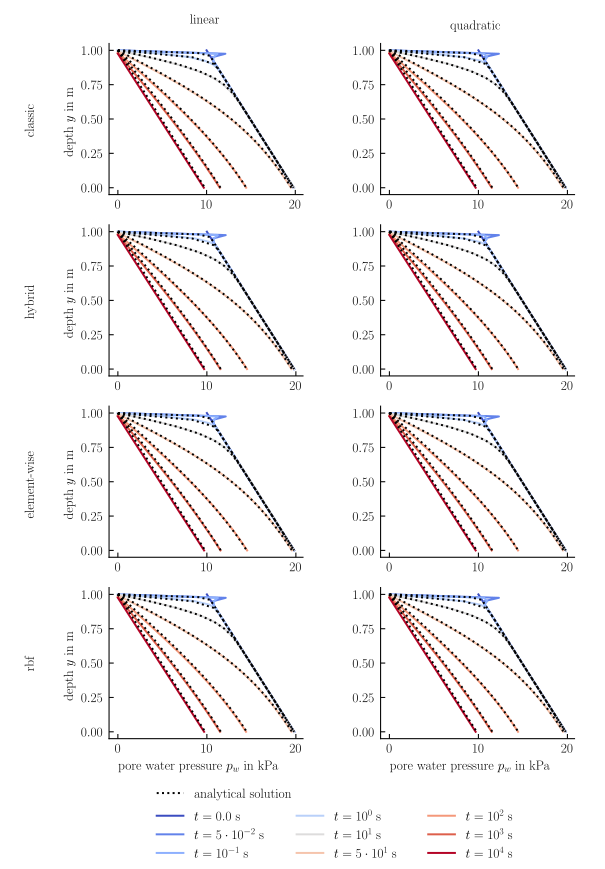
Figure 2: Comparison of simulation results for 1D wave propagation benchmark
The comparison of the PFEM simulation results with the analytical solutions (see Figure 1) shows an almost perfect agreement between simulation and analytical solution — independent of the element formulation and mapping procedure used. Nevertheless, at the time steps \(t=5 \cdot 10^{-2} \, \mathrm{s}\) and \(t=10^{-1} \, \mathrm{s}\), pressure oscillations near the drainage boundary become apparent in the numerical simulations. At the beginning of the consolidation process, \(p_w\) equals the total stress throughout the domain, except at the drainage boundary where \(p_w=0\) is prescribed. This induces steep pressure gradients in the early time steps. In this initial phase, the numerical approximation is unable to accurately resolve the steep pressure gradients in the vicinity of the draining surface, leading to the well-known pressure oscillations in consolidation simulations (Vermeer and Verruijt, 1981; Murad and Loula, 1994)4 5. As the simulation progresses, the pressure gradients diminish and can subsequently be captured with sufficient accuracy by the finite-element approximation.
-
Terzaghi, K. (1925) General theory of three-dimensional consolidation. Wien: F. Deuticke. ↩
-
Brezzi, F. and Pitkäranta, J. (1984) "On the stabilization of finite element approximations of the stokes equations," in W. Hackbusch (ed.) Efficient solutions of elliptic systems: Proceedings of a GAMM-seminar kiel, january 27 to 29, 1984. Wiesbaden: Vieweg+Teubner Verlag, pp. 11--19. Available at: https://doi.org/10.1007/978-3-663-14169-3\_2. ↩
-
Truty, A. and Zimmermann, T. (2006) "Stabilized mixed finite element formulations for materially nonlinear partially saturated two-phase media," Computer Methods in Applied Mechanics and Engineering, 195(13--16), pp. 1517--1546. Available at: https://doi.org/10.1016/j.cma.2005.05.044. ↩
-
Vermeer, P.A. and Verruijt, A. (1981) "An accuracy condition for consolidation by finite elements," International Journal for Numerical and Analytical Methods in Geomechanics, 5(1), pp. 1--14. Available at: https://doi.org/10.1002/nag.1610050103. ↩
-
Murad, M.A. and Loula, A.F.D. (1994) "On stability and convergence of finite element approximations of biot's consolidation problem," International Journal for Numerical Methods in Engineering, 37(4), pp. 645--667. Available at: https://doi.org/10.1002/nme.1620370407. ↩