Penetration of a rigif footing into Tresca soil
A widely studied benchmark problem in geotechnical engineering for assessing numerical methods in the presence of large deformations and evolving topologies is the penetration of a rigid strip footing into undrained clay.
The model setup follows (Kardani et al., 2015)1, who investigated this problem using an Arbitrary Lagrangian–Eulerian (ALE) formulation. The essential aspects are briefly recapitulated here for completeness. The footing has a width of \(B = 1\,\mathrm{m}\) and rests on a soil domain of width \(10B\) and height \(5B\). The soil is modelled as a weightless undrained clay whose behaviour is described by the Tresca model. The material parameters are the undrained Young’s modulus \(E_u=100\,\mathrm{kPa}\), undrained Poisson’s ratio \(\nu_u=0.495\), and undrained shear strength \(s_u=1\,\mathrm{kPa}\), resulting in a rigidity index of \(I_r=G/s_u=33.4\). The penetration process is simulated by prescribing a vertical displacement \(\tilde{u}_y\) up to \(1B\) for all nodes beneath the footing, while horizontal displacements along the vertical boundaries and vertical displacements along the bottom boundary are constrained to zero.
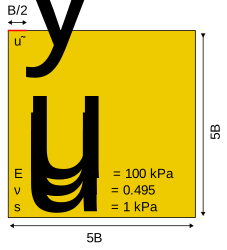
Figure 1: Model setup for the rigid strip footing on undrained clay
For a weightless soil with an undrained friction angle of \(\varphi_u = 0\), the ultimate bearing capacity \(q_u\) is given analytically as
\(q_u = N_c \cdot s_u\) ,
where \(N_c = 2 + \pi\) according to Prandtl’s solution. This classical expression is derived under the assumptions of small displacements and perfect plasticity, i.e., geometric nonlinearities are neglected. In contrast, large-deformation analyses such as those performed with numgeo-PFEM capture the continuous soil resistance mobilization and generally predict higher ultimate bearing capacities than Prandtl’s solution.
The numgeo-PFEM results are presented in Figure 1, showing the normalized resistance \(q_u/s_u\) as a function of the normalized penetration depth \(z/B\). The results are compared to the analytical solution by Prandtl as well as to reference data from the literature. In particular, the sequential limit analysis (SLA) solution by (Silva et al., 2011)2, which is widely regarded as a benchmark reference, is included. Further comparisons are made with PFEM simulations by (Monforte et al., 2017)3 employing mixed elements (\(\mathbf{u}3p3\), where the mean pressure \(p\) is introduced as additional degree of freedom), smoothed PFEM simulations by (Zhang et al., 2018)4 (SPFEM, employing a strain smoothening technique to mitigate volumetric locking), and Material Point Method (MPM) simulations by (Sołowski and Sloan, 2014)5. The latter employed slightly different parameters (\(\nu=0.49\), \(E_u = 96\,\mathrm{kPa}\), \(s_u = 1\,\mathrm{kPa}\), \(I_r=32.2\)).
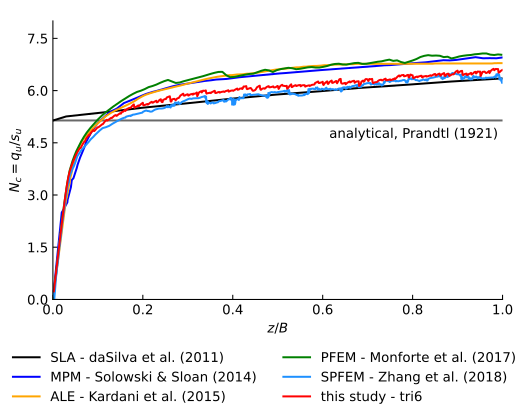
Figure 2: Normalized resistance of a strip footing on undrained clay (\(I_r = 33.4\))
The results obtained with numgeo-PFEM show good agreement with the reference solution by (Silva et al., 2011)2 and with the SPFEM results, while the ALE, MPM, and PFEM mixed-element simulations predict slightly higher normalized resistances. These findings confirm that also for elasto-plastic soil models, the use of quadratically interpolated elements within PFEM effectively mitigates volumetric locking. This can also be seen from the smooth mean pressure fields \(p_{mean}\) depicted in Figure 3 for different normalized penetration depths.
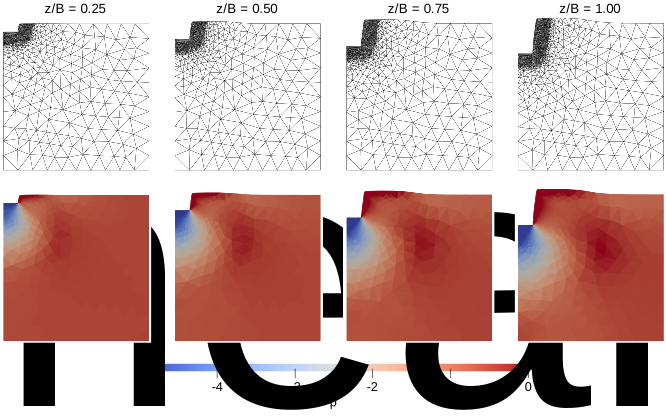
Figure 3: Computational mesh and mean pressure \(p_{mean}\) at different normalized penetration depth \(z/B\) for the simulation of a strip footing on undrained clay
To further evaluate the robustness of the PFEM approach, a parametric study was performed by varying the rigidity index to \(I_r~\in~\{16, 167, 500\}\). The results are compared to PFEM and SPFEM simulation results reported by (Monforte et al., 2017)3 and (Zhang et al., 2018)4 as well as the reference solution by (Silva et al., 2011)2. Again, the PFEM results of the present study show very good agreement with SPFEM results, while the mixed-element PFEM results by (Monforte et al., 2017)3 yield consistently higher normalized resistances across all investigated \(I_r\) values. The present PFEM approach correctly captures the faster increase of resistance with increasing stiffness as well as the convergence to equal normalized resistance once the failure mechanism is fully developed.
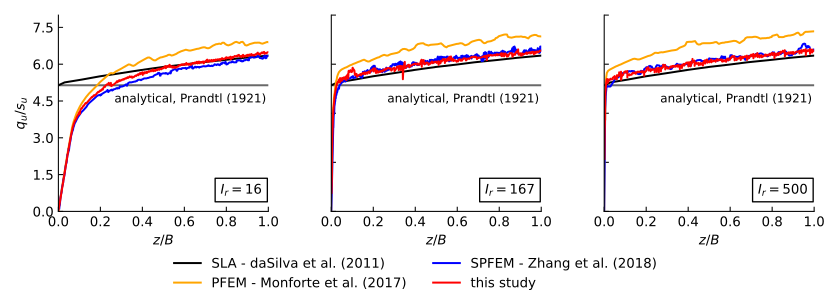
Figure 4: Normalized resistance of a strip footing on undrained clay for different rigidity indices \(I_r\)
-
Kardani, M. et al. (2015) "Efficiency of high-order elements in large-deformation problems of geomechanics," International Journal of Geomechanics, 15(6). Available at: https://doi.org/10.1061/(asce)gm.1943-5622.0000457. ↩
-
Silva, M.V. da et al. (2011) "Rigid-plastic large-deformation analysis of geotechnical penetration problems," Proceedings of the 13th international conference of the international association for computer methods and advances in geomechanics (IACMAG). New South Wales, Australia: University of New South Wales, Centre for Infrastructure Engineering; Safety, pp. 42--47. ↩↩↩
-
Monforte, L. et al. (2017) "Numerical simulation of undrained insertion problems in geotechnical engineering with the particle finite element method (PFEM)," Computers and Geotechnics, 82, pp. 144--156. Available at: https://doi.org/10.1016/j.compgeo.2016.08.013. ↩↩↩
-
Zhang, W. et al. (2018) "Smoothed particle finite-element method for large-deformation problems in geomechanics," International Journal of Geomechanics, 18(4). Available at: https://doi.org/10.1061/(asce)gm.1943-5622.0001079. ↩↩
-
Sołowski, W.T. and Sloan, S.W. (2014) "Evaluation of material point method for use in geotechnics," International Journal for Numerical and Analytical Methods in Geomechanics, 39(7), pp. 685--701. Available at: https://doi.org/10.1002/nag.2321. ↩