Cone penetration test in Toyoura sand
This application of numgeo-PFEM presents the back-calculation of a cone penetration test (CPT) in Toyoura sand. The physical test was conducted in a calibration chamber with an inner diameter of \(1.2\,\mathrm{m}\) and a height of \(1.5\,\mathrm{m}\). The cone penetrometer had a diameter of \(35.7\,\mathrm{mm}\) and a tip angle of \(60^{\circ}\). No geometric simplifications, such as a smoothening of the transition from tip to shaft, was considered, testing the robustness of the implemented algorithm. As in the experiment, the cone penetrometer was pushed displacement controlled in the soil with a constant penetration rate of \(2\,\mathrm{cm/s}\). Further details on the calibration chamber and experimental procedure are reported in (Bellotti et al., 1982; Fioravante et al., 1991)1 2. Exploiting the rotational symmetry of the setup, an axisymmetric model was adopted. The mechanical behaviour of the soil was described by the Sanisand model (Dafalias and Manzari, 2004)3, with material parameters for Toyoura sand taken from (Moshfeghi et al., 2024)4.
The interaction between cone penetrometer and soil was modelled using a Coulomb friction model with a wall friction angle of \(\delta = \tfrac{1}{3}\varphi = 10.4^{\circ}\). The choice of \(\delta\) is consistent with measurements in interface tests conducted by (Vogelsang, 2017)5, who reported friction angles between \(10^{\circ}\) and \(15^{\circ}\) for smooth steel–sand contact. For the contact discretisation, a mortar-based contact formulation was used, reducing mesh sensitivity for large relative tangential displacements between the contacting bodies. Details on the contact implementation are described in (Staubach, 2022)6.
A schematic representation of the numerical model is shown in Figure 1.
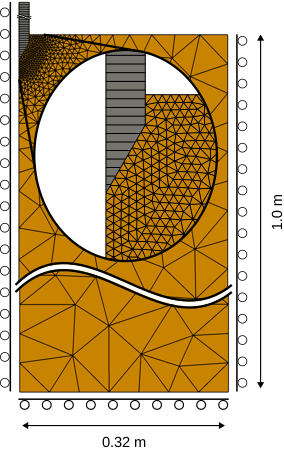
Figure 1: Geometry of the numerical model for the back-calculation of CPT in Toyoura sand
The animation below illustrates the penetration of the cone into the calibration chamber, including the continuous remeshing of the particle cloud during the simulation. The computed tip resistance \(q_c\) and sleeve friction \(f_s\) are presented as functions of normalised penetration depth. The normalised penetration depth \(\tilde{u}_y\) is defined as follows:
\(\tilde{u}_y = \frac{u_y}{r_{cone}}\)
where \(u_y\) is the vertical displacement of the cone penetrometer and \(r_{cone}\) is the radius of the cone shaft.
The simulation results show very good agreement with the experimental measurements of the cone tip resistance \(q_c\) and sleeve friction \(f_s\). These results demonstrate the applicability of numgeo-PFEM to advanced geotechnical boundary value problems, including those involving sophisticated constitutive material models that are sensitive to perturbations in their state variables.
-
Bellotti, R. et al. (1982) "Design, construction and use of a calibration chamber," Proceedings of the 2nd european symposium on penetration testing. Amsterdam. ↩
-
Fioravante, V. et al. (1991) "Calibration chamber tests on toyoura sand," Proceedings of the 1st international symposium on calibration chamber testing (ISOCCT1). Potsdam: New York, pp. 135--146. ↩
-
Dafalias, Y.F. and Manzari, M.T. (2004) "Simple plasticity sand model accounting for fabric change effects," Journal of Engineering Mechanics, 130(6), pp. 622--634. Available at: https://doi.org/10.1061/(asce)0733-9399(2004)130:6(622). ↩
-
Moshfeghi, S. et al. (2024) "Impact of evolving fabric anisotropy on CPT simulations for subsurface characterization," 7th international conference on geotechnical and geophysical site characterization. Barcelona, Spain: CIMNE (ISC 2024). Available at: https://doi.org/10.23967/isc.2024.293. ↩
-
Vogelsang, J. (2017) Untersuchungen zu den mechanismen der pfahlrammung. PhD thesis. Karlsruher Institut für Technologie (KIT); Karlsruher Institut für Technologie (KIT). ↩
-
Staubach, P. (2022) Contributions to the numerical modelling of pile installation processes and high-cyclic loading of soils. PhD Thesis. Publications of the Chair of Soil Mechanics, Foundation Engineering; Environmental Geotechnics, Ruhr-University Bochum, Issue No. 73. Available at: https://doi.org/10.13154/294-9088. ↩