Cone penetration test in Tresca soil
The simulation of a cone penetration test (CPT) in undrained clay modelled using a Tresca constitutive model is a widely adopted benchmark for evaluating numerical methods capable of handling large deformations, topological changes, and evolving contact conditions. This benchmark has been investigated using various numerical approaches over a wide range of rigidity indices \(I_r=G/s_u\).
Under undrained conditions, a common measure for evaluating CPT results is the dimensionless cone factor \(N_c\), which relates the measured cone tip resistance \(q_c\) to the undrained shear strength \(s_u\) and the initial vertical stress \(\sigma_{v0}\):
\(N_c = \frac{q_c - \sigma_{v0}}{s_u}\)
This quantity is also used here to compare the simulation results with those reported in the literature.
The numerical model uses an axisymmetric formulation, exploiting the rotational symmetry of the system. The soil domain extends to a radius of \(r_{\text{soil}} = 0.84~\mathrm{m}\) and a height of \(h = 1.0~\mathrm{m}\). The penetrometer cone itself has a radius of \(r_{\text{cone}} = 17.85~\mathrm{mm}\) and a tip angle of \(60^{\circ}\). The penetration of the penetrometer cone into the soil body is prescribed with a constant penetration rate of \(2~\mathrm{cm/s}\).
The transition between the cone tip and the penetrometer shaft is modelled sharply, without geometric simplifications such as rounding. This modelling choice is intended to highlight the robustness of the implemented numerical algorithms. The undrained shear strength of the soil is \(s_u = 18~\mathrm{kPa}\), and the Poisson’s ratio is set to \(\nu = 0.495\) in order to represent nearly incompressible behaviour under undrained loading. The initial stress state is assumed to be isotropic, with \(\sigma_{v0} = \sigma_{h0} = 66~\mathrm{kPa}\). The contact between the penetrometer cone and the soil is modelled frictionless. The domain is discretised using quadratically interpolated displacement-based finite elements (tri6).
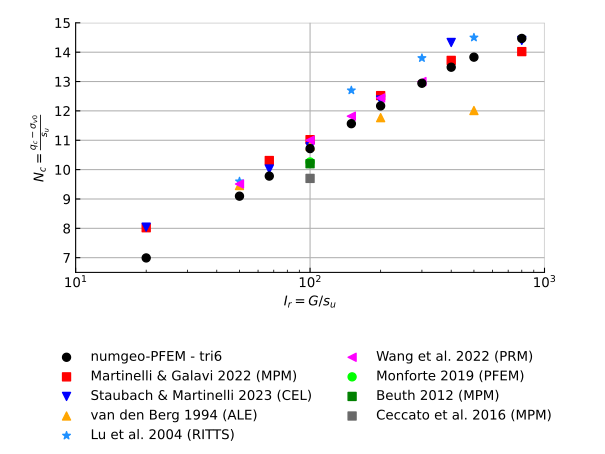
Figure 1: Comparison of cone factors \(N_c\) for different rigidity indices \(I_r\) from different simulation methods
Figure 1 compares the computed \(N_c\) values as a function of \(I_r\) with results reported in the literature. The \(N_c\) values obtained using numgeo-PFEM reproduce the general trend observed in previous studies and lie within the scatter of the reported results across the investigated range of \(I_r\) range. Only for \(I_r = 20\) a noticeable underestimation of \(N_c\) is observed when compared to the results reported by (Martinelli and Galavi, 2022; Staubach and Martinelli, 2023)1 2.
The overall agreement with published results also indicates that volumetric locking — potentially arising from the nearly incompressible material response (\(\nu = 0.495\)) — is effectively mitigated by the use of quadratically interpolated displacement-based elements.
-
Martinelli, M. and Galavi, V. (2022) "An explicit coupled MPM formulation to simulate penetration problems in soils using quadrilateral elements," Computers and Geotechnics, 145, p. 104697. Available at: https://doi.org/10.1016/j.compgeo.2022.104697. ↩
-
Staubach, P. and Martinelli, M. (2023) "MPM vs. CEL: Numerical modelling of penetration processes," Symposium on Energy Geotechnics 2023, pp. 1--2. Available at: https://doi.org/10.59490/seg.2023.600. ↩