Undrained monotonic triaxial test (CU)
In a consolidated–undrained (CU) triaxial test the specimen is sheared with drainage prevented, so that excess pore pressures develop. Measuring the pore pressure (or the total and effective stresses) yields the effective stress path, the undrained shear strength and the pore-pressure response.
What it constrains
Undrained triaxial tests constrain the effective stress path and undrained strength, showing how the soil contracts or dilates under shear when volume change is suppressed. They are especially valuable for models intended for saturated, poorly drained or seismic conditions, and they complement drained tests by probing the same shear behaviour under a different drainage constraint.
How numgeo-ACT simulates it
numgeo reproduces the undrained triaxial test as a single axisymmetric finite
element (U4-solid-ax) representing a cylindrical specimen with \(r = h/2\). In
the FE model the directions are \(x_1\) (radial) and \(x_2\) (axial); \(\sigma_1^0\) is
the radial (cell) stress and \(\sigma_2^0\) the axial stress.
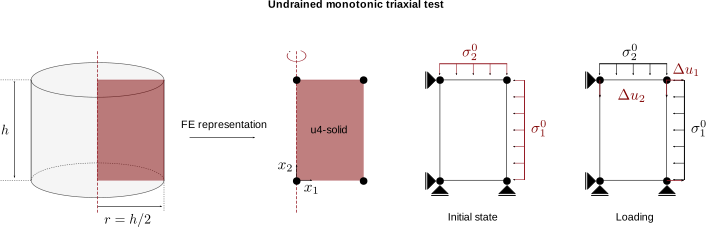
The conditions under which the test is simulated are:
- Symmetry:
u₁ = 0on the axis (nleft) andu₂ = 0at the base (nbottom). - Consolidation: the recorded cell stress (lateral face) and axial stress (top face) are applied in a geostatic step, starting from \(e_0\).
-
Undrained shearing with enforced constant volume: rather than modelling the pore water explicitly, the undrained (constant-volume) condition is enforced kinematically. The axial displacement \(\Delta u_2\) is prescribed and the radial displacement is prescribed at the same time as
\[\Delta u_1 = -\frac{r}{2h}\,\Delta u_2,\]so that the volumetric strain increment \(\mathrm{d}\varepsilon_v = \mathrm{d}\varepsilon_{\text{ax}} + 2\,\mathrm{d}\varepsilon_{\text{rad}} = 0\). Because incompressibility comes from this constraint, the pore-fluid bulk modulus is removed from the material. It is not needed and would only stiffen the system numerically. - Outputs: the effective stress path (\(p\)–\(q\)), the deviatoric stress–strain response and the back-figured pore pressure are compared to your data.
numgeo element test
For the full numgeo input and a step-by-step description, see the numgeo tutorial Undrained monotonic triaxial test.
Data mapping (CU-# sheet)
| Cell / column | Meaning | Units |
|---|---|---|
B1 |
initial void ratio \(e_0\) | – |
| row 2 | column headers (informational) | – |
| column 0 (from row 3) | axial strain \(\varepsilon_1\) (in %) | % |
| column 1 (from row 3) | cell pressure \(\sigma_3\) | kPa |
| column 2 (from row 3) | axial stress \(\sigma_1\) | kPa |
| column 3 (from row 3) | mean effective stress \(p\) | kPa |
| column 4 (from row 3) | deviatoric stress \(q\) | kPa |
| column 5 (optional) | initial-state string(s) | – |
p and q can be derived from the stresses
If you record \(\sigma_1\) and \(\sigma_3\) (and the pore pressure), the mean and deviatoric stresses follow as \(p = (\sigma_1 + 2\sigma_3)/3\) and \(q = \sigma_1 - \sigma_3\). The example database computes the \(p\) and \(q\) columns from the measured stresses; if you do the same, make sure the resulting values are present in the sheet (the reader reads numbers, not spreadsheet formulas; see the note below).
Provide values, not live formulas
The reader extracts the numeric content of each cell. If your \(p\)/\(q\) columns are computed by spreadsheet formulas, keep them as evaluated values when you save (the supplied template and the reformatted example database already store plain values).
The full specification is on the
Excel sheet reference.
A CU-1 example sheet is included in the
template.