Drained monotonic triaxial test (CD)
In a consolidated–drained (CD) triaxial test the specimen is sheared slowly enough that no excess pore pressure develops; drainage is allowed throughout. The measured response includes the deviatoric stress and the volumetric strain as functions of axial strain, capturing both shear strength and dilatancy.
What it constrains
Drained triaxial tests are a core monotonic constraint on shear strength and dilatancy. They inform the critical-state friction angle, the peak strength and the volumetric (contractive or dilative) response. It therefore constrains parameters such as the critical friction angle and the dilatancy-controlling parameters of each model.
How numgeo-ACT simulates it
numgeo reproduces the drained triaxial test as a single axisymmetric finite
element (U4-solid-ax) representing a cylindrical specimen with \(r = h/2\). In
the FE model the directions are \(x_1\) (radial) and \(x_2\) (axial); \(\sigma_1^0\) is
the radial (cell) stress on the lateral face and \(\sigma_2^0\) the axial stress on
the top.
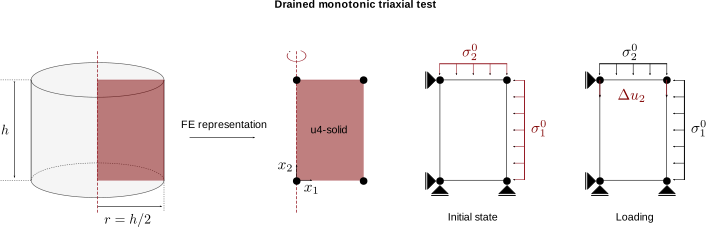
The conditions under which the test is simulated are:
- Symmetry: radial displacement fixed on the axis (
u₁ = 0onnleft) and vertical displacement fixed at the base (u₂ = 0onnbottom). - Consolidation: the recorded cell stress is applied to the lateral face and the axial stress to the top face in a geostatic step (starting from \(e_0\)).
- Shearing: the cell pressure is held constant on the lateral face while the axial displacement is prescribed at the top (strain-controlled, via a ramp). The deviatoric stress \(q\) and the volumetric strain develop in response and are compared to your data.
- Drainage: drained. The solid element carries effective stresses and the volumetric strain is free (no excess pore pressure).
Constant-mean-pressure tests
A drained triaxial test can be run either at constant cell pressure
(\(\sigma_3 = \text{const.}\)) or at constant mean pressure
(\(p = \text{const.}\)). numgeo-ACT supports both: the D1 cell of the sheet is a
flag (yes/no) that tells the reader which control was used. When constant
mean pressure is active, column 1 is interpreted as \(p\) rather than \(\sigma_3\).
numgeo element test
For the full numgeo input, see the numgeo tutorials Drained monotonic triaxial test and, for a test with load reversals, Drained triaxial test with unloading/reloading.
Data mapping (CD-# sheet)
| Cell / column | Meaning | Units |
|---|---|---|
B1 |
initial void ratio \(e_0\) | – |
C1 |
test name (informational) | – |
D1 |
constant-pressure flag: yes / no (empty = no) |
– |
| row 2 | column headers (informational) | – |
| column 0 (from row 3) | axial strain \(\varepsilon_1\) (in %) | % |
| column 1 (from row 3) | cell pressure \(\sigma_3\), or mean pressure \(p\) if D1 = yes |
kPa |
| column 2 (from row 3) | deviatoric stress \(q\) | kPa |
| column 3 (from row 3) | volumetric strain \(\varepsilon_v\) (in %) | % |
| column 4 (optional) | initial-state string(s) | – |
Triaxial strains are in percent
On the triaxial sheets (CD, CU, CUCYC) the strain columns are given in
percent. The reader divides them by 100 internally. This differs from
the oedometer / isotropic-compression sheets, which use fractions.
The full specification, including the constant-pressure flag and the optional
initial-state column, is on the
Excel sheet reference.
A CD-1 example sheet is included in the
template.