High-cycle accumulation (HCA) tests
High-cycle accumulation tests apply a large number of small-amplitude load cycles (thousands to hundreds of thousands) and track the slow accumulation of strain (drained) or pore pressure (undrained) over those cycles. They are the calibration target for the HCA-Sand model, which describes long-term cyclic behaviour without resolving every single cycle.
numgeo-ACT supports both drained and undrained HCA triaxial tests:
- Drained high-cyclic triaxial: sheet
CDCYC_HCA-# - Undrained high-cyclic triaxial: sheet
CUCYC_HCA-#
Both sheets share the same structure; only the drainage condition (and hence the dominant accumulated quantity) differs.
What it constrains
HCA tests constrain the accumulation behaviour under high-cyclic loading: the rate at which residual strain (drained) or excess pore pressure (undrained) grows with the number of cycles, and how that rate depends on amplitude, density and stress level. This is exactly the information the HCA model needs.
How numgeo-ACT simulates it
The HCA tests are reproduced with a coupled solid–pore-fluid axisymmetric
element (U4p4-sat-mini-ax) with \(r = h/2\). Unlike the other element tests,
the pore water is modelled explicitly, so the drained vs. undrained behaviour
follows from the permeability and the pore-fluid bulk modulus you provide,
together with the pore-pressure boundary. In the FE model \(x_1\) is radial and
\(x_2\) axial.
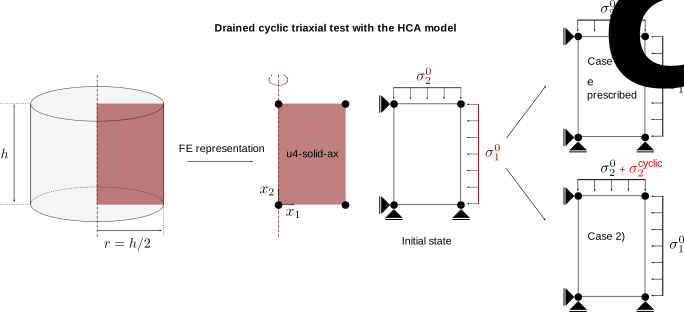
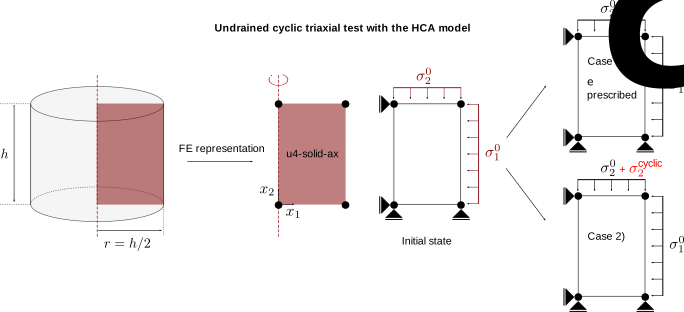
The conditions under which the tests are simulated are:
- Symmetry / consolidation:
u₁ = 0on the axis,u₂ = 0at the base; the cell stress (lateral) and axial stress (top) are applied in a geostatic step, and a hydrostatic pore-pressure boundary sets the initial pore pressure. - Two loading modes (selected by the sheet's mode/source flags
B6/B7):- Case 1, prescribed strain amplitude: the cyclic strain amplitude \(\varepsilon^\text{ampl}\) is prescribed (held constant, or updated during the run from the simulation).
- Case 2, superimposed cyclic stress: a cyclic axial stress \(\sigma_2^\text{cyclic}\) is added to the axial stress \(\sigma_2^0\) (a sine amplitude on the top face).
- Drainage: the drained (
CDCYC_HCA) and undrained (CUCYC_HCA) cases differ in the drainage / pore-pressure boundary and the assigned permeability. In both, the HCA model advances the accumulation over the prescribed number of cycles rather than resolving every individual cycle.
numgeo element tests
For the full numgeo inputs and step-by-step descriptions, see the numgeo tutorials Drained cyclic triaxial test with the HCA model and Undrained cyclic triaxial test with the HCA model.
Data mapping (CDCYC_HCA-# / CUCYC_HCA-# sheets)
| Cell | Meaning | Units |
|---|---|---|
B1 |
initial void ratio \(e_0\) | – |
B2 |
deviatoric stress amplitude \(q^\text{ampl}\) | kPa |
B3 |
axial stress \(\sigma_1\) | kPa |
B4 |
cell stress \(\sigma_3\) | kPa |
B6 |
strain-amplitude mode (1 = constant, 2 = updated) | – |
B7 |
strain-amplitude source (1 = user, 2 = from simulation) | – |
B8 |
strain-amplitude parameter | – |
B9 |
dry density \(\rho_d\) | – |
B10 |
permeability | – |
B11 |
pore-fluid bulk modulus \(K_w\) | kPa |
A12 |
test name (informational) | – |
| Column (from the data row) | Meaning | Units |
|---|---|---|
| column 0 | number of cycles \(N_\text{acc}\) | – |
| column 1 | accumulated axial strain \(\varepsilon_1^\text{acc}\) (in %) | % |
| column 2 | accumulated strain \(\varepsilon^\text{acc}\) | % |
| column 3 | accumulated volumetric strain \(\varepsilon_v^\text{acc}\) | % |
| column 4 | accumulated deviatoric strain \(\varepsilon_q^\text{acc}\) | % |
| column 5 | accumulated pore pressure \(p_w^\text{acc}\) | kPa |
| column 6 | strain amplitude \(\varepsilon^\text{ampl}\) | – |
| column 7 | void-ratio (experimental) | – |
| column 8 (optional) | initial-state string(s) | – |
Drained vs. undrained
In a drained HCA test the accumulated strains are the primary measured response; in an undrained HCA test the accumulated pore pressure is. Fill in whichever quantities your test recorded; the column positions are the same for both sheet types.
The complete cell-by-cell specification (including the precise data start row and
the optional initial-state column) is on the
Excel sheet reference.
CDCYC_HCA-1 and CUCYC_HCA-1 example sheets are included in the
template.