Hydraulic model
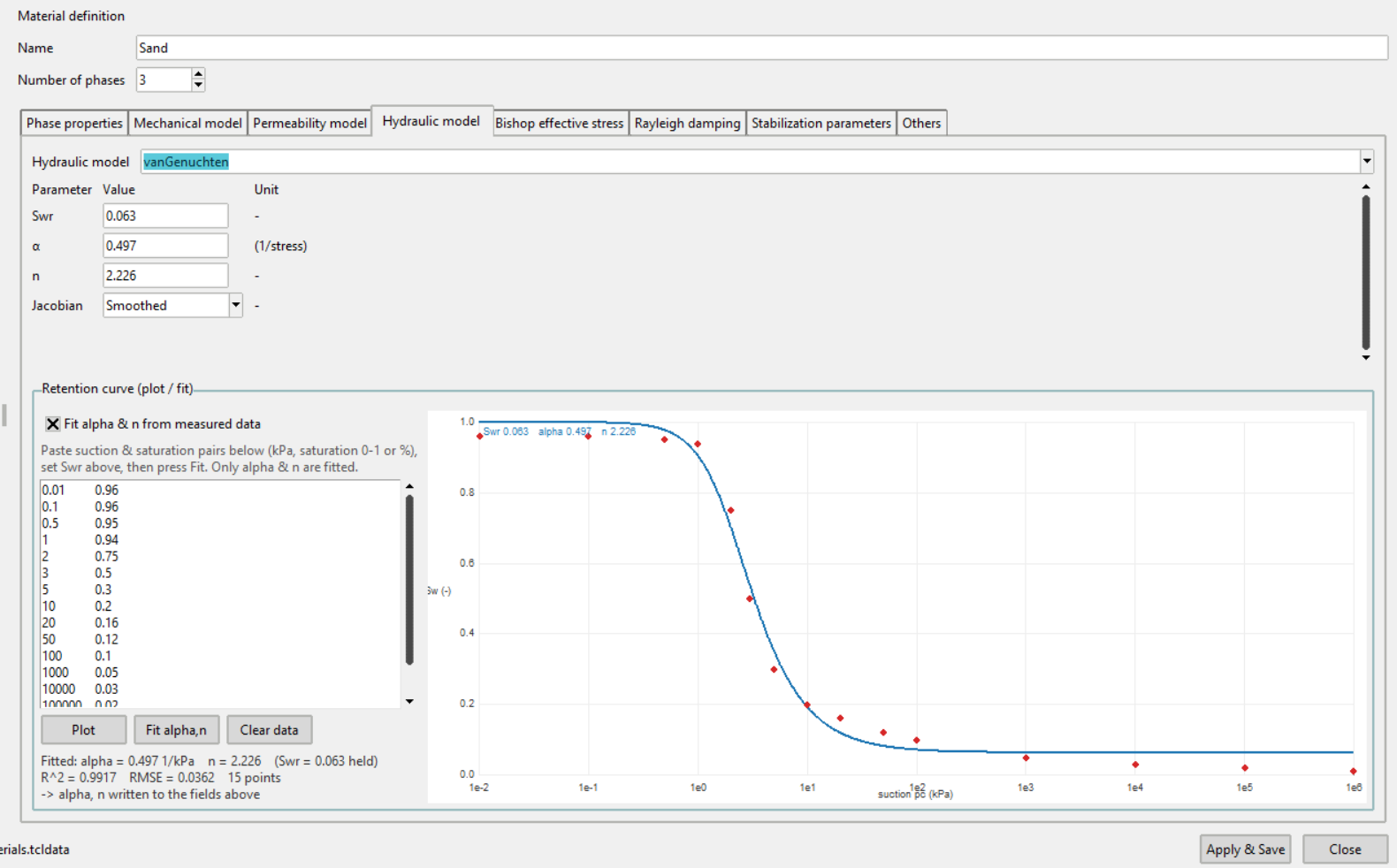
The Hydraulic model tab holds the soil-water retention curve — how the saturation of the soil changes with suction. It appears for three-phase materials only.
Available models
| Model | Parameters | Reference |
|---|---|---|
| vanGenuchten | Swr, α, n |
Van Genuchten |
| Brooks-Corey | Swr, lambda, p^b |
Brooks & Corey |
| Fredlund-Xing | hr, af, nf, mf |
Fredlund & Xing |
| Exponential model | Swr, zeta |
Exponential |
| Gallipoli model | Swr, phi, psi, m, n |
Gallipoli |
| User-defined | — |
Each model also carries a Jacobian setting, which defaults to Smoothed.
Retention curve
The panel at the bottom draws the retention curve — saturation Sw against
suction pc, with suction on a logarithmic axis. It works two ways.
Plotting a known curve
If the parameters are already known, type them into the fields above and press Plot. The curve is drawn from the field values and redrawn whenever they change, so the effect of each parameter can be seen directly.
Fitting parameters to measured data
If a measured SWRC is available, the parameters can be obtained from it instead of being estimated by hand.
- Select vanGenuchten as the hydraulic model.
- Enter
Swrin the field above. It is not fitted, so it must be supplied —0is a valid value. - Tick Fit alpha & n from measured data.
- Paste the measured suction–saturation pairs into the data box, one pair per line: suction in kPa first, then saturation.
- Press Fit alpha,n.
The fitted α and n are written into the fields above, the curve is redrawn
through the measured points, and the quality of the fit is reported underneath
as R², RMSE and the number of points used.
Clear data empties the box and discards the fit.
What the data may look like
Pairs may be separated by spaces, tabs, commas or semicolons. Lines beginning
with # are ignored, as are lines that do not hold two numbers.
Saturation may be given as a fraction or as a percentage — values above 1.5 are taken as percent and divided by 100, so a column of measurements between 0 and 100 needs no conversion.
Suction must be positive; a pair with zero or negative suction is skipped. At least three valid pairs are needed before a fit can be attempted.
About the fit
Only α and n are optimised, and Swr is held at the value in the field
above. The residuals are weighted by log spacing, so that the decades at high
suction — where measurements are sparse — carry as much influence as the
crowded points near saturation. The optimiser is started from several initial
guesses of air-entry pressure and pore-size distribution and keeps the best
result, which avoids settling on a poor local fit.
Fitting is available for vanGenuchten only. Selecting another model and pressing Fit alpha,n or Plot reports that vanGenuchten is required.
Validation
A hydraulic model is optional. If one is selected, its parameters must all be filled with numbers; pressing Apply & Save with something missing shows a warning naming the problem, and the material stays open so it can be corrected.