Permeability model
The Permeability model tab describes how easily fluid moves through the soil. It appears for two- and three-phase materials; a single-phase material has no fluid to move.
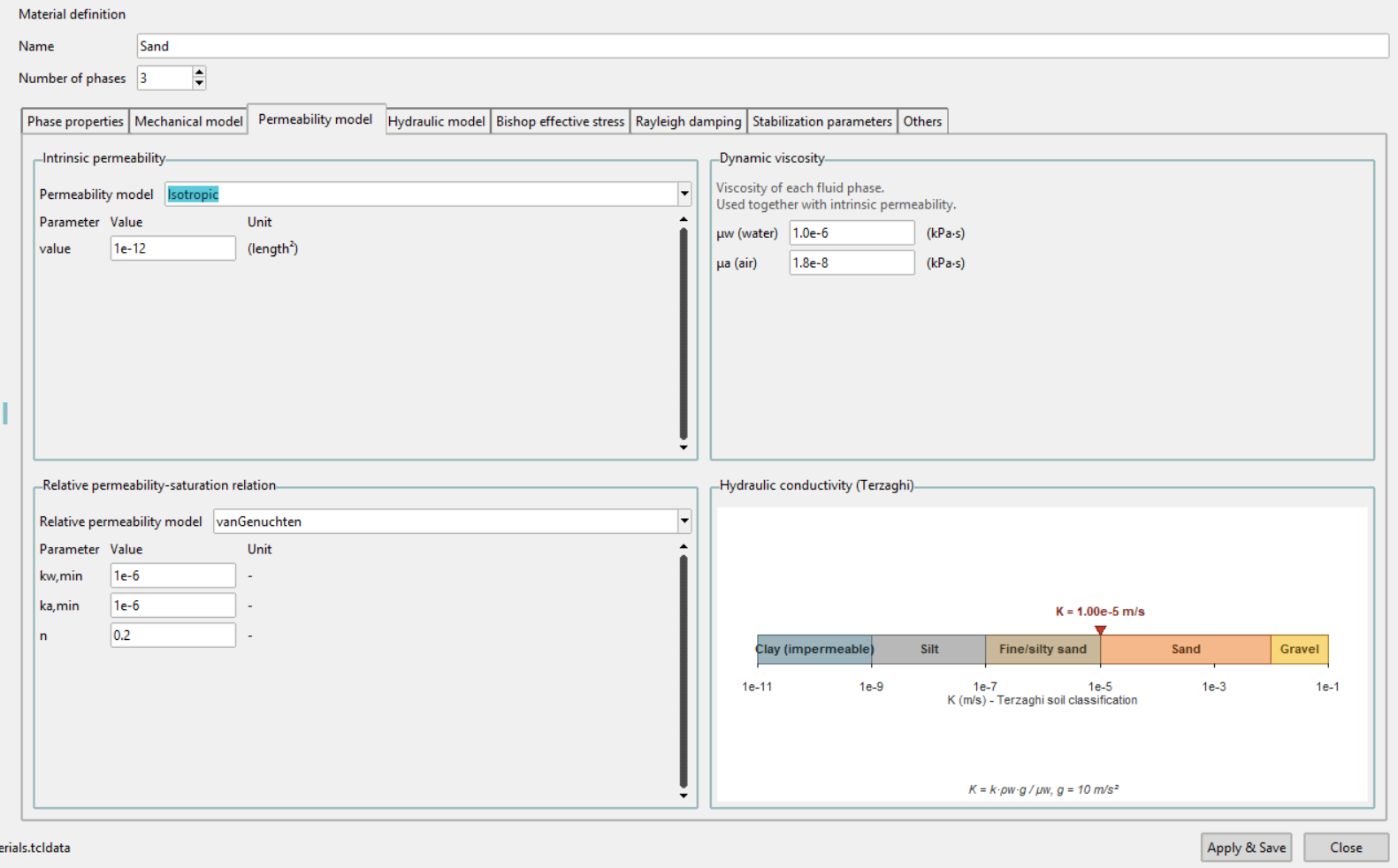
The tab holds four sections. Which of them are shown depends on the number of phases.
Intrinsic permeability
The permeability of the soil skeleton itself, independent of the fluid in it.
| Model | Parameters | Reference |
|---|---|---|
| Isotropic | a single value, in length² | Permeability |
| Kozeny-Carman | c, de |
Permeability |
| User-defined | — |
Dynamic viscosity
The viscosity of each fluid phase, in kPa·s. It is used together with the intrinsic permeability.
| Row | Shown at |
|---|---|
| μw (water) | two or three phases |
| μa (air) | three phases |
Relative permeability-saturation relation
Shown for three-phase materials only. In unsaturated soil neither water nor air occupies the whole pore space, and this relation describes how the permeability of each falls away as the other takes over.
| Model | Parameters | Reference |
|---|---|---|
| vanGenuchten | kw,min, ka,min, n |
Van Genuchten |
| Brooks-Corey | kw,min, ka,min, n |
Brooks & Corey |
| User-defined | — |
Leaving the model unselected is allowed. Once one is chosen, its parameters must be filled.
Hydraulic conductivity scale
Intrinsic permeability is not the number most geotechnical engineers carry in their head — hydraulic conductivity is. The scale in the lower right does that conversion so the value being entered can be recognised:
The resulting K is marked on the Terzaghi soil-classification bands — clay,
silt, fine and silty sand, sand, gravel — so an implausible permeability shows
up at a glance. Entering a value that lands a sand in the clay band is a sign
that k is wrong, or has been entered in the wrong units.
The scale is a readout, not an input. It cannot be typed into, and it updates live as the permeability, the water density or the water viscosity change. The water density comes from the Phase properties tab, so the marker moves when that is edited too.
Validation
For two- and three-phase materials an intrinsic permeability model must be chosen and its parameters filled. A relative permeability model is optional, but once selected its parameters are required as well.
Pressing Apply & Save with something missing shows a warning naming the problem, and the material stays open so it can be corrected.