Beam elements
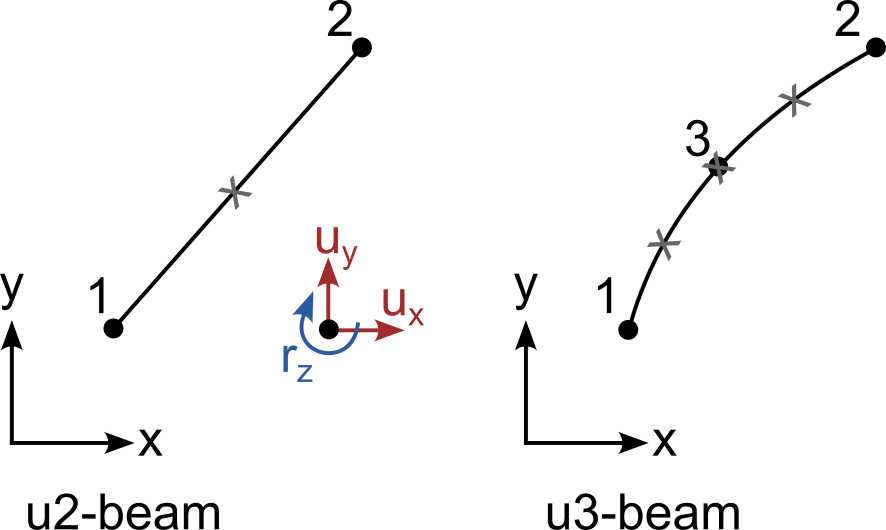
Beam elements are structural members capable of resisting axial forces, shear forces and bending moments. They model slender structural elements where one dimension is significantly larger than the other two. The currently implemented beam elements use a Timoshenko beam formulation and therefore account for both bending and shear deformation. Details on the implementation are provided in the Theory Manual.
The properties of beam elements are assigned using the *Material keyword in combination with the *Beam properties sub-keyword. See the Reference Manual for more information.
If a material density is specified using *Density, it is used for the consistent beam mass matrix. If body forces are active, the same density is also used to generate the equivalent distributed beam load. Without *Density, no density-based inertia or self-weight contribution is generated.
Beam degrees of freedom
Beam nodes have translational and rotational degrees of freedom. In 2D, each beam node has u1, u2 and r3. In 3D, each beam node has u1, u2, u3, r1, r2 and r3. Boundary conditions therefore need to restrain the relevant rotational degrees of freedom as well; otherwise rigid-body mechanisms may remain.
2D Elements
| Element label | Dim. | Shape | Nodes | Order | nIP* |
|---|---|---|---|---|---|
u2-beam |
2D | beam | 2 | linear | 1 |
u3-beam |
2D | beam | 3 | quadratic | 3 |
* nIP = number of integration points
For 2D beam elements, the active nodal degrees of freedom are u1, u2 and r3. The relevant local beam resultants are the normal force \(N\), the local shear force \(Q_y\) and the bending moment \(M_z\).
3D Elements
| Element label | Dim. | Shape | Nodes | Order | nIP* |
|---|---|---|---|---|---|
u2-beam-3D |
3D | beam | 2 | linear | 1 |
u3-beam-3D |
3D | beam | 3 | quadratic | 3 |
* nIP = number of integration points
For 3D beam elements, the active nodal degrees of freedom are u1, u2, u3, r1, r2 and r3. The local \(x\)-axis is aligned with the beam axis. The local \(y\)- and \(z\)-axes are generated internally from the element orientation. For non-circular or otherwise direction-dependent cross-sections, the orientation of \(I_{yy}\), \(I_{zz}\), \(\kappa_y\) and \(\kappa_z\) therefore has to be considered carefully.
Notes on density and body forces
The density defined by *Density is interpreted as mass density. For beam elements it contributes to:
- the translational inertia through \(\rho A\),
- the rotary inertia through \(\rho I_{yy}\) and \(\rho I_{zz}\),
- the torsional rotary inertia in 3D through \(\rho(I_{yy}+I_{zz})\),
- the equivalent density-based body-force vector if body forces are active.
For body-force loading, the distributed line load is formed from the material density, the cross-sectional area and the prescribed body-force direction/magnitude. The resulting external load is assembled consistently with the beam interpolation. In the 2-node formulation, the equivalent nodal force vector includes the corresponding fixed-end moment terms for constant transverse line loads. In the 3-node formulation, the equivalent load vector is integrated over the beam axis using the element shape functions.
Notes on output
For beam elements, \(\sigma_{11}\) is the axial stress and \(\sigma_{12}\) and \(\sigma_{13}\) correspond to the shear stresses in local \(xy\)- and \(xz\)-direction, respectively. All other components are zero.
Similarly, \(\varepsilon_{11}\) is the axial strain and \(\varepsilon_{12}\) and \(\varepsilon_{13}\) correspond to the shear strains in local \(xy\)- and \(xz\)-direction, respectively.
In addition to general output in Cartesian coordinates such as displacements, stress and strain, local quantities can be requested:
Beam-Force-N: normal force along the beam axis in FBeam-Force-Qy: shear force in local \(y\)-direction in FBeam-Force-Qz: shear force in local \(z\)-direction in FBeam-Moment-Mz: bending moment around the local \(z\)-axis in F·LBeam-Moment-My: bending moment around the local \(y\)-axis in F·L
In 2D, only Beam-Force-N, Beam-Force-Qy and Beam-Moment-Mz are relevant. In 3D, Beam-Force-Qz and Beam-Moment-My are available in addition.
See the Theory Manual for information about the calculation of forces and bending moments.