Spring-ground-n: elastic block on a linear normal spring bed
This benchmark verifies Spring-ground-n and its relative formulation against a closed-form solution. A rectangular, linear-elastic body occupying \([0,1.0]\times[0,0.1]\) m (plane strain, unit out-of-plane thickness) is laterally confined (\(u_x=0\)) on its left and right edges, supported at the bottom edge by a bed of Spring-ground-n springs, and loaded by a uniform pressure \(p\) on the top edge. Self-weight is neglected, so that the only load is the applied pressure.
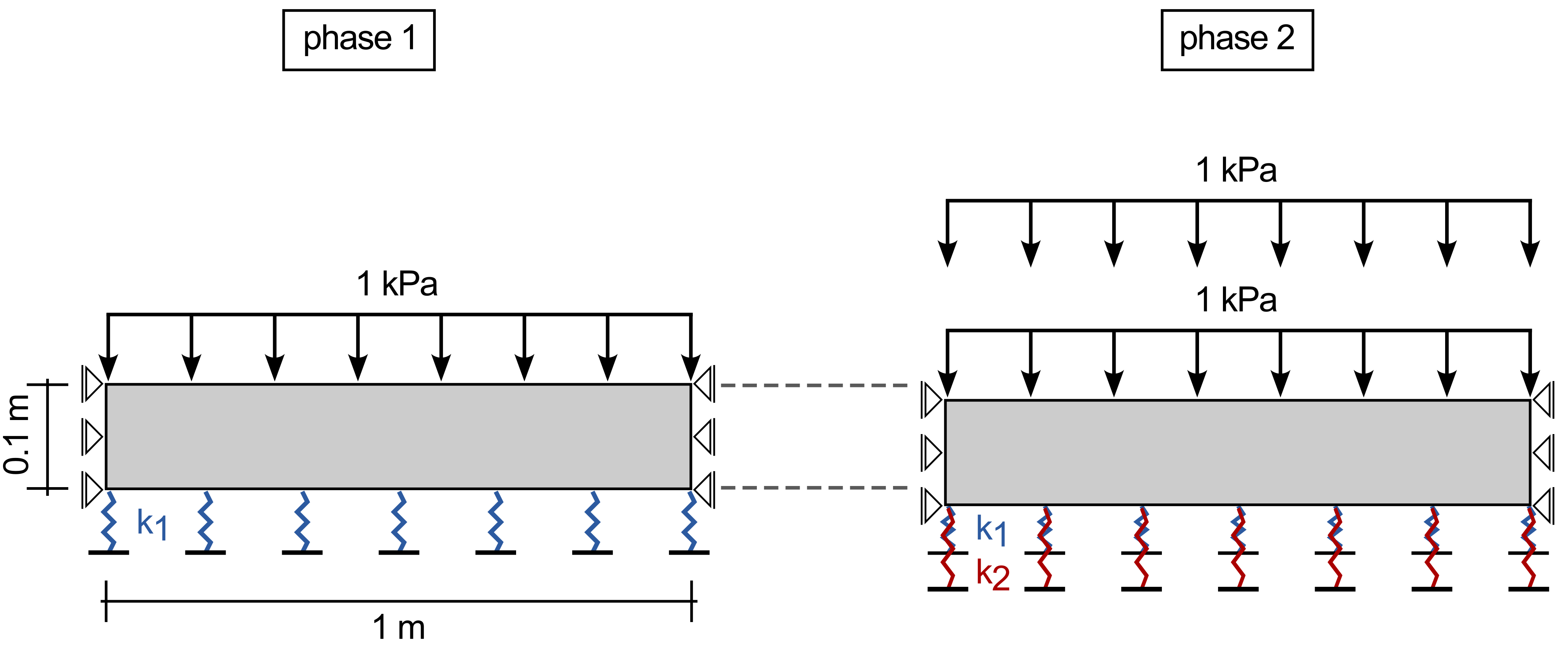
Figure 1: Model setup (not to scale).
The linear-elastic body is modelled using a Young's modulus of 2 GPa and a Poisson's ratio of 0.3. The simulation consists of two phases:
- Phase 1: the base of the elastic-body is supported by vertical springs with constant stiffness of \(k_1=10\) kPa/m. A compressive load is applied at the top of the body. The load is linearly increasing from 0 kPa to 1 kPa over a time of 1 second (quasi-static conditions).
- Phase 2: An additional set of springs is attached to the base of the model, again acting in vertical direction. The spring stiffness is \(k_2=20\) kPa/m. The springs are added strain-free, relative to the current configuration. The load from phase 1 remains constant in this phase but is augmented by a second compressive load, again linearly increasing from 0 kPa to 1 kPa over a time of 1 seconds such that at the end of the phase, a total of 2 kPa is acting on the top surface of the body.
Because the lateral boundary condition rules out any \(x\)-strain and the problem is otherwise 1D, the deformation is exactly a uniaxial (oedometric/\(K_0\)) compression: \(\varepsilon_{xx}=\varepsilon_{zz}=0\), only \(\varepsilon_{yy}\neq0\).
Input files
Download the input file here
Results
Neglecting self-weight, vertical equilibrium of the body requires the vertical stress \(\sigma_{yy}\) to be constant with height, so the spring reaction exactly equals the applied pressure, \(q_{\text{spring}}=1\), and the base settlement due to spring compression alone is
The body's own uniaxial-strain compression can be neglected due to the combination of low external pressure (max 2 kPa) and high Young's modulus.
The total downward displacement of the loaded (top) edge is therefore
For stage one, the resulting displacements are
The settlements at the end of phase 2 are a result of the settlements of phase 1 and any additional settlements from the newly applied load. The springs \(k_1\) and \(k_2\) act in parallel, such that the final settlements at the end of phase 2 are calculated as
A comparison of the simulation results and the analytical ones is given in Figure 2.
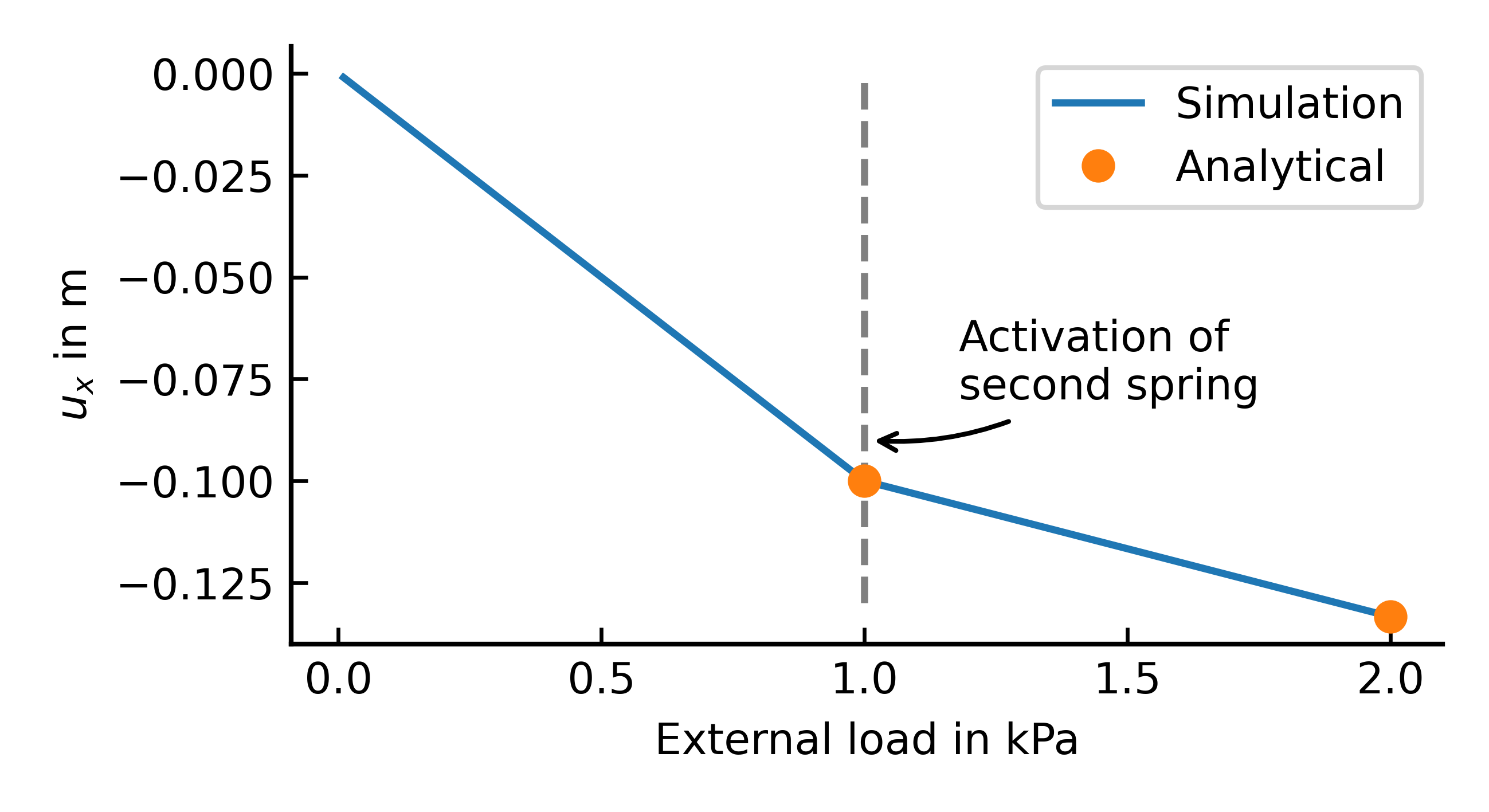
Figure 2: Simulation results vs. analytical results for the spring supported elastic body under uniform compressive load