Embedded anchor pull-out (2D)
This benchmark verifies the implementation of *Embedded region, interaction (embedded beams) by means of the pull-out of a truss (anchor) embedded in a rigid host region, for which the analytical solution is trivial.
Upcoming release
The *Embedded region, interaction feature will be available with the upcoming release
Model
A soil block of 2.0 m x 1.0 m is discretised with four U4-SOLID elements. All soil nodes are fully fixed, rendering the host region rigid. A grout body idealised as a truss (three U2-TRUSS elements, \(EA = 10^6\) kN) extends from \(x = 0.25\) m to \(x = 1.75\) m at \(y = 0.5\) m; the truss nodes deliberately do not coincide with any soil nodes. The embedded length is \(L = 1.5\) m. The interface is defined by
resulting in a pull-out capacity of \(t_{ult} \cdot L = 15\) kN. The tendon attached at the right end of the grout body and is as well idealised as a linear truss element. A schematic of the model is depicted in Figure 1.
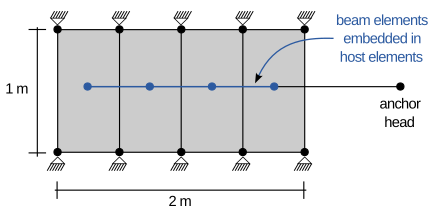
Figure 1: Model setup (not to scale).
Input files
Download the input file here
Step 1: elastic pull-out (load controlled)
A concentrated load of \(F = 7.5\) kN < \(t_{ult} \cdot L\) is applied to the anchor head. Since the host is rigid and the truss is (almost) inextensible, the relative displacement is uniform along the embedded length and the anchor head displacement follows from
The truss elongation \(F \cdot l / (EA) \approx 10^{-5}\) m is negligible. numgeo reproduces the analytical solution; the simulation converges in one iteration per increment (linear system). A comparison of the simulation results to the analytical solution is provided in Figure 2.
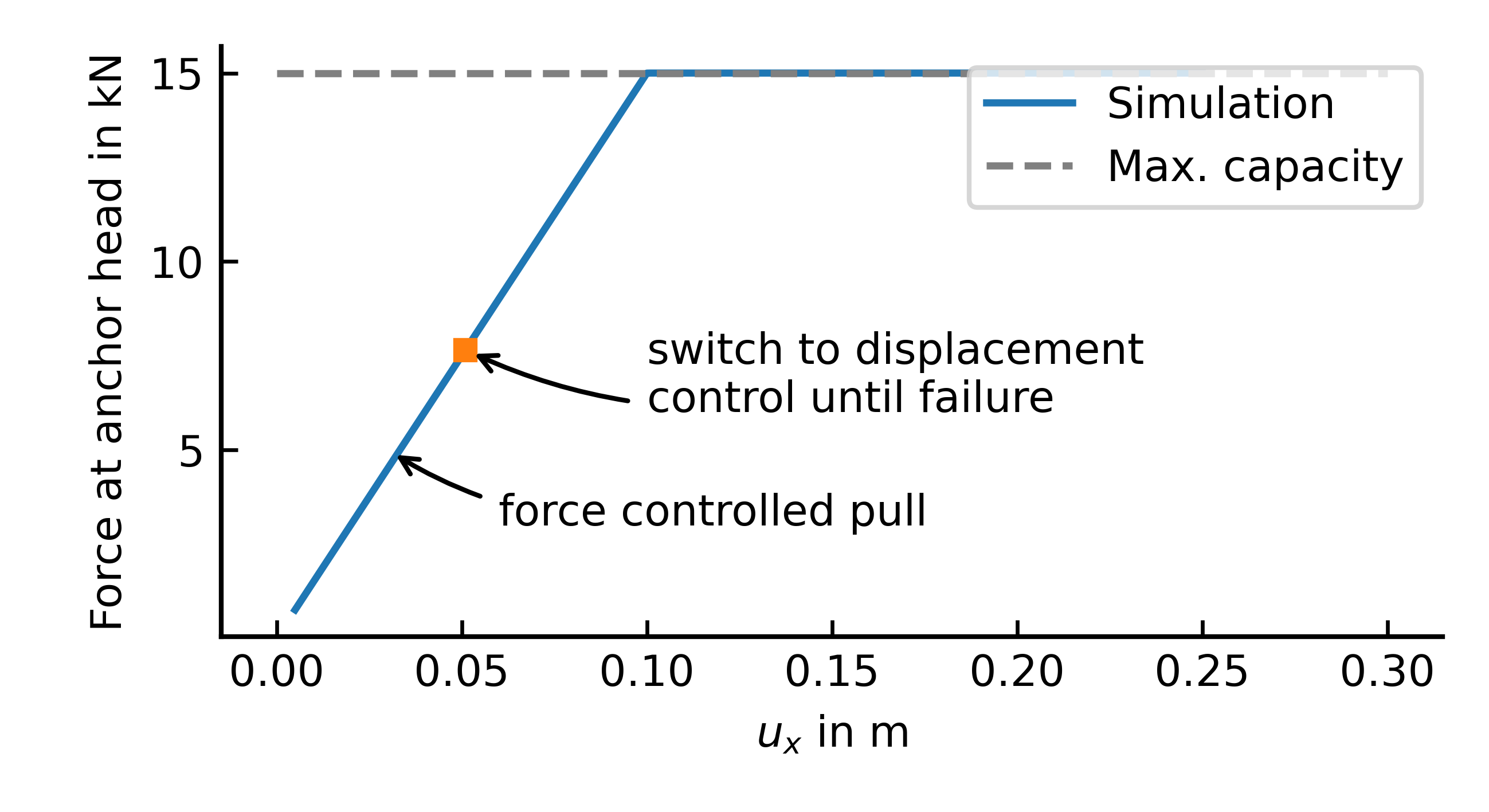
Figure 2: Simulation results vs. analytical solution.
Step 2: pull-out capacity (displacement controlled)
The anchor head displacement is increased to \(u_1 \approx 0.25\) m. All integration points of the interface reach the ultimate skin traction and slide; the reaction force at the anchor head equals the pull-out capacity
independent of the imposed displacement. The plastic slip stored at the interface integration points is committed at the end of each converged increment; unloading (not part of this benchmark) would follow the elastic stiffness \(k_t\).
Note that this is exactly the regime in which the guest element has moved far relative to the host (\(u_1 = 0.25\) m over an embedded length of \(L = 1.5\) m): the interface stays engaged throughout, saturating at \(t_{ult}\) instead of losing contact with the host, see Behaviour under large relative slip.