Interaction surface: laterally loaded pile (H)
This benchmark assesses the complete three-dimensional interaction-surface response under horizontal loading. Unlike axial loading, it activates circumferential variation of normal gap and pressure, trailing-side separation, circumferential traction, base sliding and the moment transfer produced by cross-section lever arms. Interaction surfaces were introduced specifically to represent these mechanisms 12.
Input files
The three-dimensional continuum reference and the embedded models of this benchmark are part of the manuscript study; the input files are not distributed with the documentation. The keyword line of the embedded models is given below; the axial benchmarks and the tutorial provide complete input files.
Continuum reference model
The pile has diameter \(D=0.80\,\mathrm m\), embedded length \(L=8.0\,\mathrm m\) and Young's modulus \(E_p=30\,\mathrm{GPa}\). The soil parameters are those of the axial benchmarks. Symmetry reduces the \(10\times10\times20\,\mathrm m\) domain to a \(10\times5\times20\,\mathrm m\) half-model. All reported pile-head reactions are twice the reaction obtained from this half-model.
The resolved pile is discretised by fully integrated solid elements. The soil uses reduced-integration hexahedra with hourglass stabilisation and strong local grading around the pile. Unilateral normal and Mohr–Coulomb tangential contact act at shaft and base. A \(50\,\mathrm{mm}\) thick high-stiffness head extension distributes the prescribed horizontal displacement across the pile head. The response is indistinguishable from the original centre-node loading, showing that the reported reference curve is not controlled by load introduction.
The final displacement is
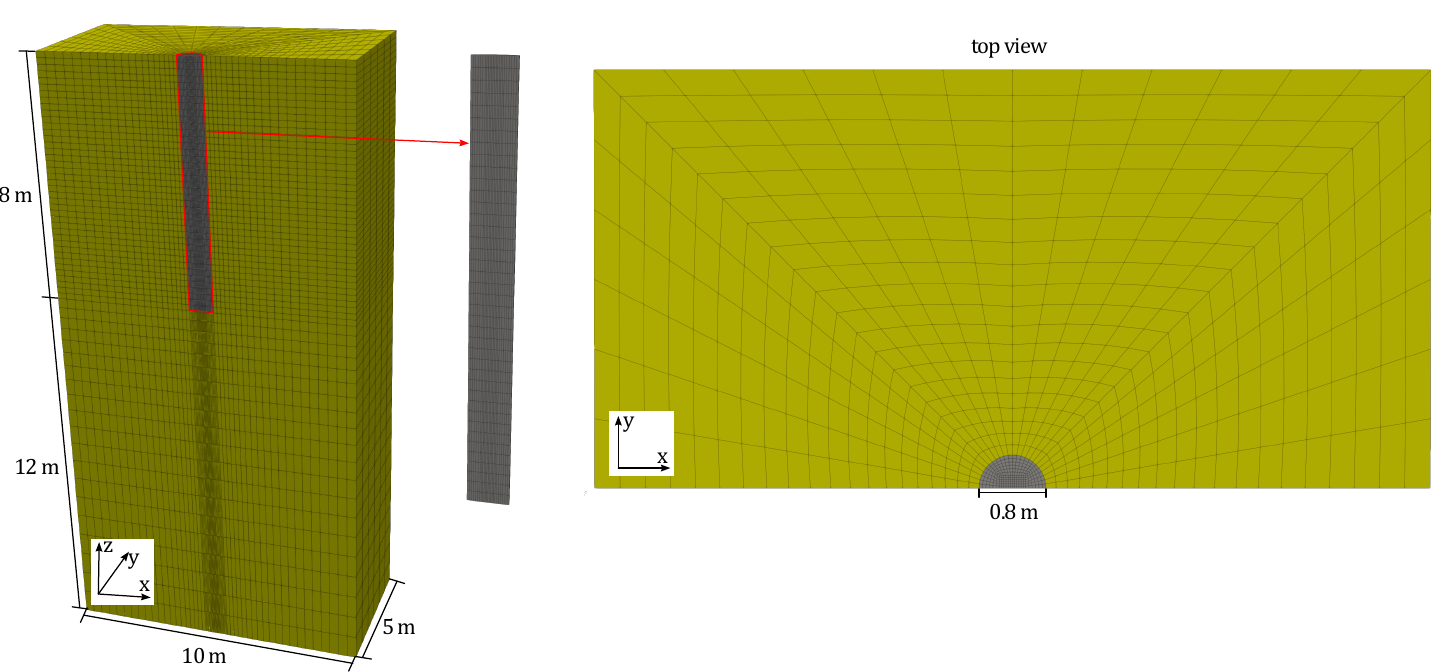
Symmetry half-domain, resolved pile and locally graded continuum mesh.
Embedded model
The shaft uses type=Mohr-Coulomb, sigma=soil, Gaussian recovery with lrec=1, tension=no, and ghost=shaft:
*Embedded region, interaction-surface, type=mohr-coulomb, sigma=soil, recovery=gaussian, lrec=1, tension=no, ghost=shaft, baselaw=hyperbolic, bfac=18.5, bexp=0.255
pile-shaft, soil, pile-toe, 0.8, 43760, 481357, 264413, 0.75, 25.11, 1691, 75000, 0.3
The reference interaction parameters are held fixed throughout the mesh study:
| Parameter | Value |
|---|---|
| \(k_t\) | \(43.76\,\mathrm{MN/m^3}\) |
| \(k_n\) | \(481.36\,\mathrm{MN/m^3}\) |
| \(k_b\) | \(264.41\,\mathrm{MN/m^3}\) |
| \(\sigma_{\lim}\) | \(1.691\,\mathrm{MPa}\) |
BFAC \(f\) |
\(18.5\) |
BEXP \(m\) |
\(0.255\) |
| \(E_{\mathrm{ghost}}\) | \(75\,\mathrm{MPa}\) |
| \(\nu_{\mathrm{ghost}}\) | \(0.30\) |
NP, NB |
\(8\), \(9\) |
The stiffness estimates use \(h=0.80\,\mathrm m\), \(\beta=1\), \(\nu_i=0.45\) and multipliers \(N_t=N_n=N_b=1\). Here \(\nu_i\) is a penalty parameter, not the physical soil Poisson ratio.
Host-mesh study
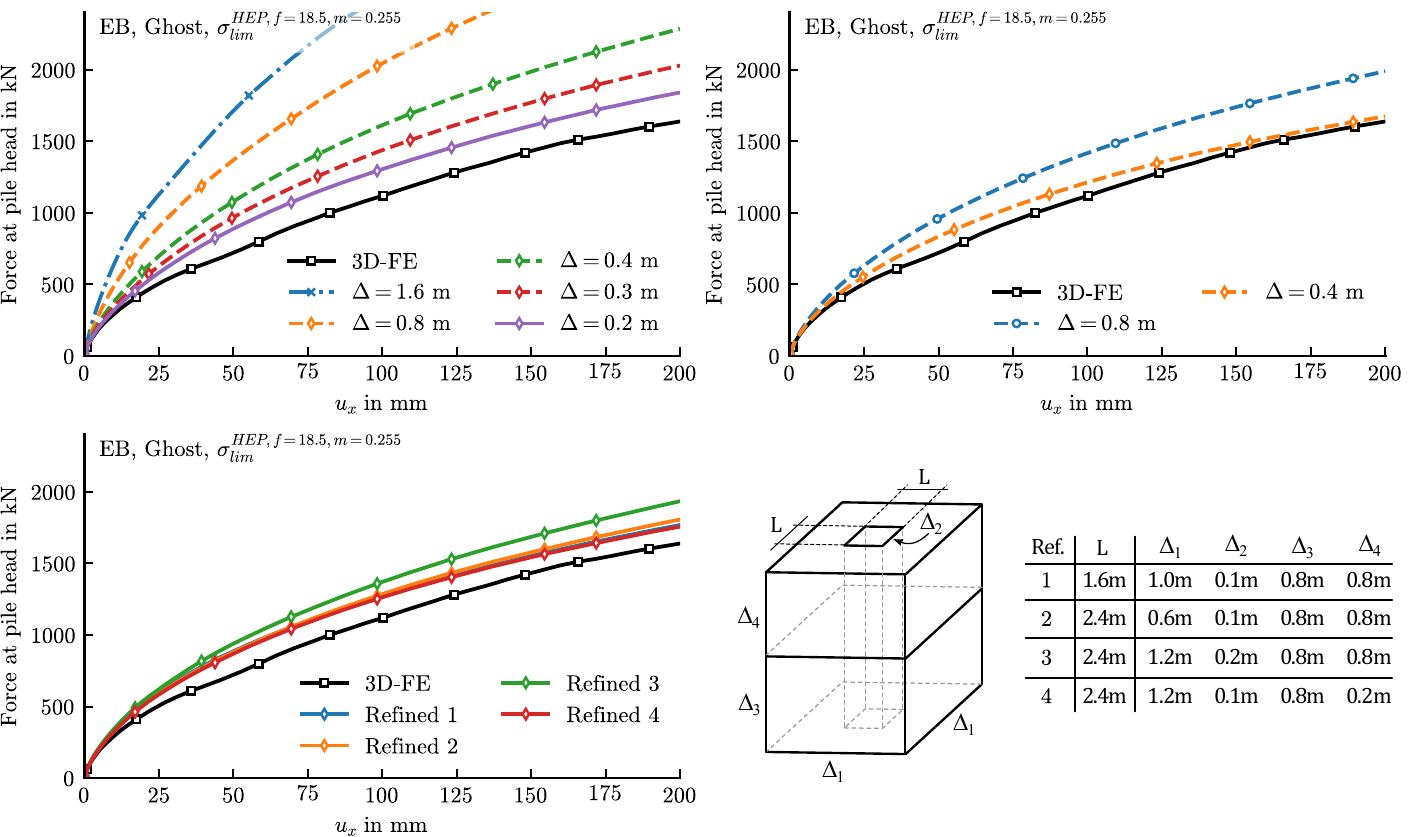
Uniform trilinear, uniform quadratic and locally refined host meshes.
Uniform trilinear meshes
With reduced-integration trilinear hexahedra, refinement produces a monotonic reduction of the lateral stiffness. At \(u_x=0.20\,\mathrm m\), the difference from the continuum reaction decreases approximately as follows:
| Near-pile size | Difference from continuum reaction |
|---|---|
| \(0.40\,\mathrm m=D/2\) | \(40\%\) |
| \(0.30\,\mathrm m\) | \(24\%\) |
| \(0.20\,\mathrm m=D/4\) | \(13\%\) |
The sequence demonstrates regular \(h\)-convergence when element family and integration rule are unchanged, but also shows that a fine host interpolation is required around the pile.
Uniform quadratic meshes
Quadratic hexahedra are substantially more accurate at the same nominal size. The \(0.40\,\mathrm m\) mesh differs from the continuum curve by only a few percent over most of the loading range. The host interpolation, not only the number of surface points, must resolve the near-pile displacement and plastic-strain gradients.
Local refinement
Four trilinear meshes refine the shaft, toe and transition region while retaining a coarse far field. Their terminal deviations are approximately \(7\)–\(18\%\). The best response is obtained when the fine zone continues below the pile and the transition is sufficiently gradual. A minimum element size alone is therefore insufficient to define an effective local refinement.
The study establishes convergence of the complete embedded discretisation. It does not imply that the interaction parameters or the integration-point representation of the ghost zone are intrinsically mesh independent.
Interaction-stiffness sensitivity
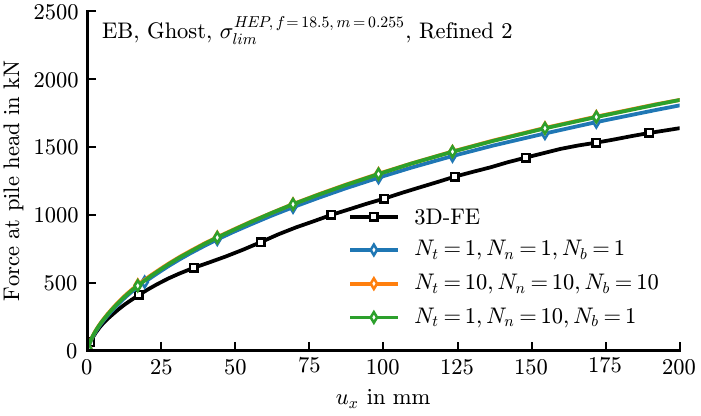
Interaction-stiffness study on locally refined mesh 2.
At \(u_x=0.20\,\mathrm m\):
| Model | Pile-head reaction |
|---|---|
| Continuum reference | \(1639\,\mathrm{kN}\) |
| \(N_t=N_n=N_b=1\) | \(1807\,\mathrm{kN}\) |
| \(N_t=N_n=N_b=10\) | \(1847\,\mathrm{kN}\) |
| \(N_t=1\), \(N_n=10\), \(N_b=1\) | \(1847\,\mathrm{kN}\) |
Increasing all interaction stiffnesses by a factor of ten changes the embedded result by only \(2.2\%\). Increasing \(k_n\) alone produces the same change within plotting resolution. The baseline is therefore close to a global penalty plateau; arbitrary common stiffness scaling cannot remove the residual difference from the continuum reference.
Pile-axis displacement and recovered stress
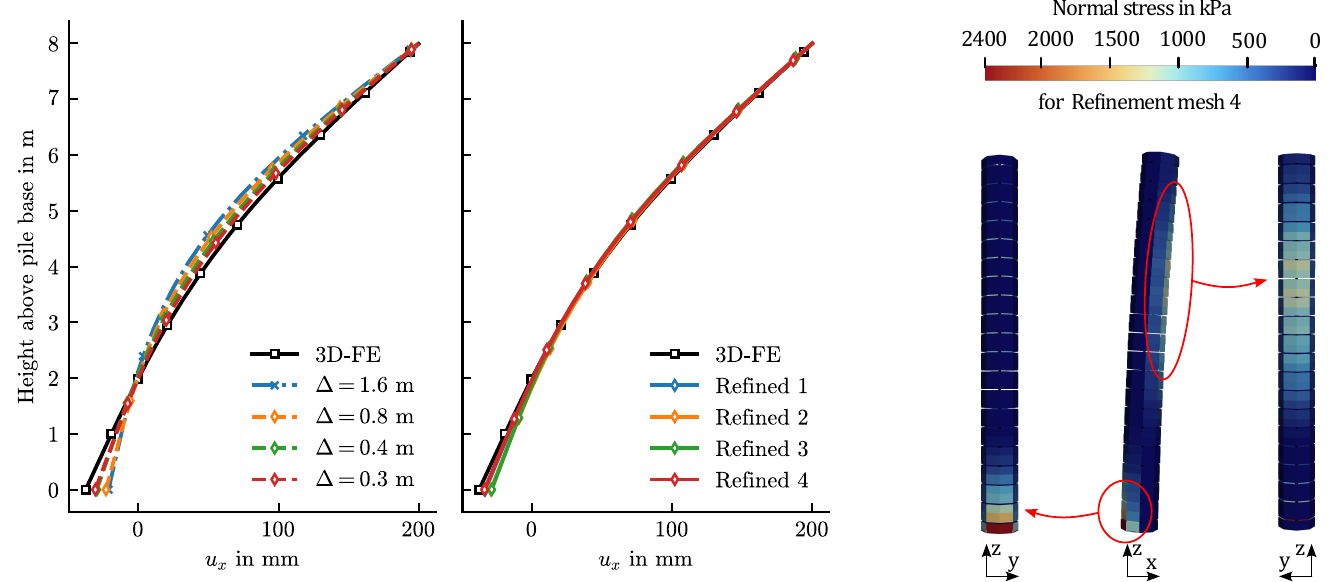
Pile-axis displacement profiles and recovered compressive normal stress at \(u_x=0.20\,\mathrm m\).
The displacement comparison uses the actual pile-axis displacement in both models. It is not reconstructed from moments or curvature.
For the uniform meshes, the maximum absolute difference from the continuum profile decreases from approximately \(16.3\,\mathrm{mm}\) at \(\Delta=1.6\,\mathrm m\) to \(6.9\,\mathrm{mm}\) at \(\Delta=0.3\,\mathrm m\). All locally refined models reproduce the counter-deflection near the toe and the curvature over the embedded length. Refined mesh 4 remains within \(3.8\,\mathrm{mm}\) of the continuum profile and has a mean absolute difference of approximately \(1.4\,\mathrm{mm}\).
The surface contour shows
namely the compressive recovered host normal stress used by the soil-stress Coulomb capacity. It is not the mechanical normal-spring traction. The field shows low or vanishing compression on the trailing side and concentrated compression on the loaded side, with the largest values near the toe. This is a qualitative assessment of the recovered field; no claim of pointwise agreement with continuum contact stress is made.
The small spaces between surface bands arise from the post-processing reconstruction of independent tributary cells centred at beam Gauss stations. They do not denote missing coupling area or physical cracks.
Verified implementation components
The benchmark exercises:
- beam translation and rotation mapping to the physical circumference;
- complete shaft traction suppression during opening and traction-free recontact;
- unilateral base opening and capped in-plane sliding;
- circumferential and axial shaft traction acting through finite lever arms;
- Gaussian host-stress recovery under non-axisymmetric loading;
- host interpolation order, uniform and local mesh refinement;
- interaction-stiffness sensitivity;
- global pile-head resistance and structural pile-axis deformation.
-
Diego F. Turello, Federico Pinto, and Pablo J. Sánchez. Embedded beam element with interaction surface for lateral loading of piles. International Journal for Numerical and Analytical Methods in Geomechanics, 40(4):568–582, 2016. doi:10.1002/nag.2416. ↩
-
Diego F. Turello, Federico Pinto, and Pablo J. Sánchez. Three dimensional elasto-plastic interface for embedded beam elements with interaction surface for the analysis of lateral loading of piles. International Journal for Numerical and Analytical Methods in Geomechanics, 41(6):859–879, 2017. doi:10.1002/nag.2633. ↩